
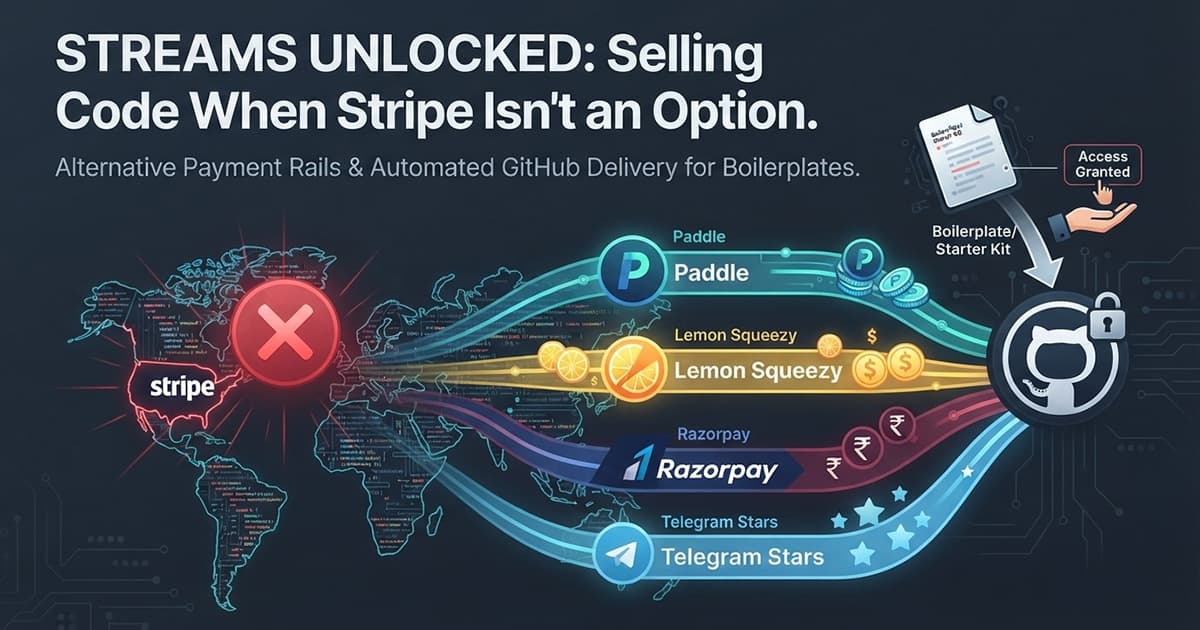
Stripe Isn't Available in My Country: How to Sell Boilerplates and Starter Kits With Paddle, Lemon Squeezy, Razorpay or Telegram Stars
Situational guide for code sellers outside Stripe: which payment rails accept sellers from their country, how each one pays out, and the delivery step none of them does - inviting the buyer to a private GitHub repo and revoking on refund.
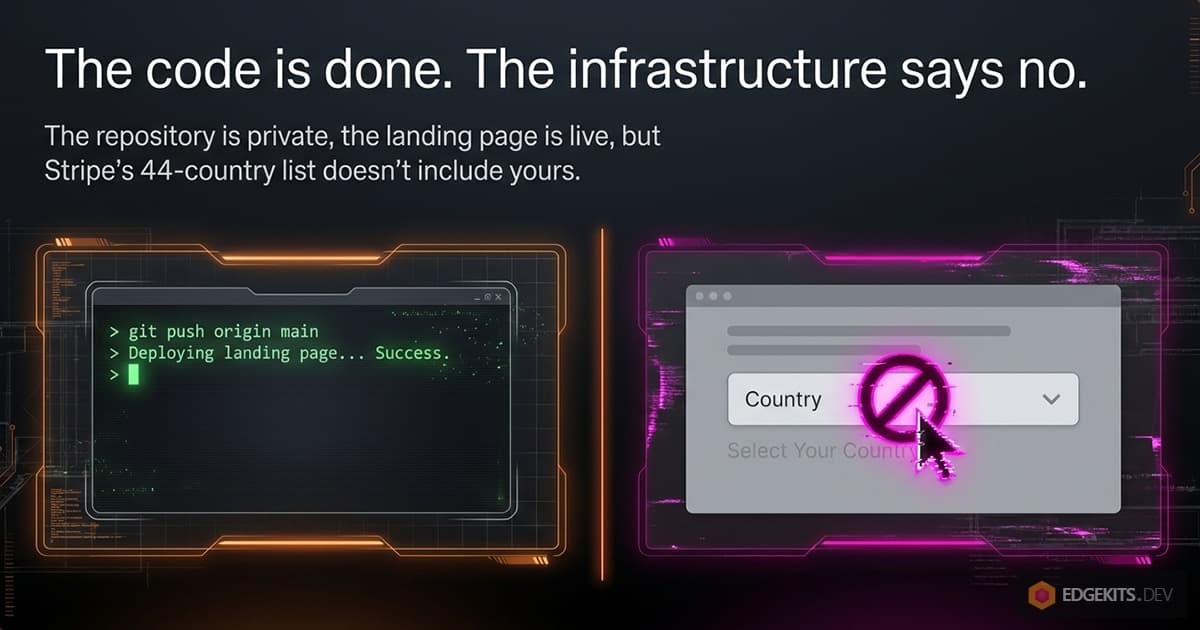
The moment usually comes after the code is done. The repo is private, the landing page is up, the price is set, and Stripe’s country dropdown does not have your country in it. What you do next decides two things at once: who collects the money, and who lets the buyer into the repository.
What “Stripe is not available in my country” changes for a code seller
Most answers to this question stop at the first half. They compare Paddle, Lemon Squeezy and Razorpay on fees and tax, and they are right that any of the three will take your money. None of them will invite a buyer to a private GitHub repo, or remove that buyer when a refund lands, and that is the half you will build yourself or buy.
This article covers both halves in order. First the rails that accept sellers from countries Stripe does not, with the numbers from each provider’s own page. Then the delivery step every one of those rails skips, and how to keep it separate from whichever rail you pick, so that changing the rail later is a setting and not a rewrite.
TL;DR
- Stripe onboards sellers from 44 countries; Paddle, Lemon Squeezy, Gumroad and Polar each accept sellers from about 120 or more
- No payment rail delivers GitHub repo access; the buyer’s invite and the refund’s revoke are always a separate layer
- Keep that layer independent of the rail, and a provider migration becomes a configuration change
- Telegram Stars is the one rail with no bank and no country list at all
Stripe supported countries for sellers: 44, two in preview, five through Paystack
Stripe’s own list has 44 fully supported countries, India and Indonesia in preview, and five African countries reached through Paystack. Everyone else gets the dropdown without their country in it. Among the missing are Turkey, Pakistan, Nigeria, Bangladesh, Egypt, Argentina, Vietnam and Ukraine.
The usual workaround is a company abroad: a US LLC or a UK Ltd with a bank account there. It works, and it costs a registration, an agent, a yearly filing and a bank that will take a non-resident. For a $99 boilerplate that is a lot of overhead to reach a checkout page. The rails below take you as you are.
Payment rails that accept sellers outside Stripe’s list
Every number in this table comes from the provider’s own supported-countries or payout page, read in September 2026. The lists change, so check yours before you build on it.
| Rail | Merchant of record | Seller countries | Payout | GitHub delivery built in | RepoAccess |
|---|---|---|---|---|---|
| Stripe | No, you are the seller of record | 44, plus India and Indonesia in preview and 5 African countries through Paystack | Bank, local currency | None | Free core adapter |
| Stripe Managed Payments | Yes | 37, after an eligibility review | Stripe payouts | None | Core adapter, matched on paper, not live-verified |
| Paddle | Yes | Everywhere except 23 countries and territories and five regions of Ukraine | Wire or Payoneer, $100 minimum, monthly | None | Pro |
| Lemon Squeezy | Yes | 119 with bank payouts, PayPal elsewhere | Bank in USD or PayPal, $50 minimum, 1st and 15th | None | Pro |
| Gumroad | Yes | 119 with bank payouts, PayPal elsewhere | Bank in local currency or PayPal in USD, $100 minimum | None | Pro |
| Polar | Yes | 119, through Stripe Connect | Through Stripe Connect | Yes, a repository access benefit | No adapter |
| Dodo Payments | Yes | 177, plus 11 for existing merchants only | Bank, $25 fee on USD wires | Yes, four months old | No adapter |
| Razorpay | No, you are the seller of record | India; sellers outside India only for Indian buyers, through Import Flow | Bank in INR, or an overseas SWIFT account on Import Flow | None | Pro |
| Telegram Stars | No bank in the loop | Anywhere Telegram works, no merchant onboarding | Toncoin through Fragment, 0.013 USD per Star, 1,000-Star minimum, up to 21 days after receipt | None | Pro |
The country column is less varied than it looks. Across Paddle, Lemon Squeezy, Gumroad and Razorpay, the roughly 200 countries outside Stripe’s list fall into ten availability patterns, and 70 of them, among them Turkey, Pakistan, Bangladesh, Egypt and Nigeria, share the same one: every merchant of record takes you, Stripe does not. If you are in that group, availability will not pick your rail for you. Payouts, tax and delivery will.
Polar and Dodo are in the table because they are the two hosted checkouts with a GitHub feature of their own, and for a single repo and a seller who wants nothing to run, either is a fair answer. Both are Stripe-backed merchants of record with wide seller lists, and I compare them with everything else in the full options guide. The rest of this article is about the rails that leave delivery to you.
The step every rail skips: getting the buyer into the private GitHub repo
A sale on any of these rails ends with a webhook and a receipt. The buyer has paid, and nothing has happened on GitHub. Somebody has to add them to the team that carries the repo, and when a refund or a chargeback arrives, somebody has to take them out again.
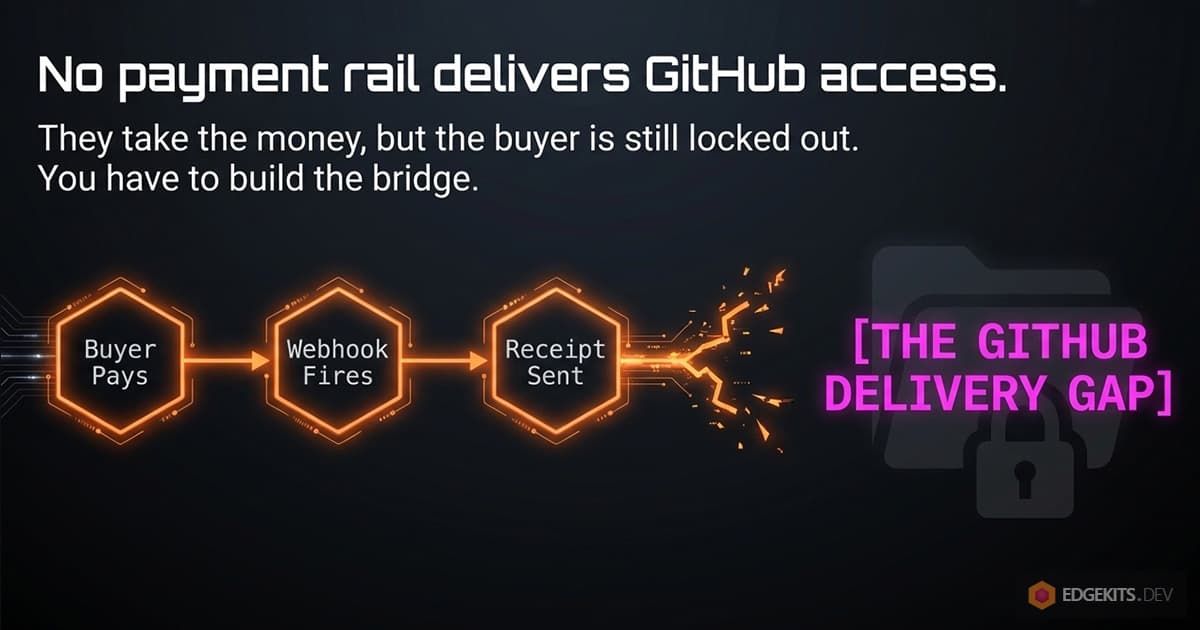
That somebody is a delivery layer, and it has three jobs. It verifies the provider’s webhook signature, so a forged request cannot grant access. It maps the product that was bought to the GitHub team that holds the code, and sends the invitation. And it reacts to the refund and dispute events with a revoke, because a buyer who keeps the repo after a refund has been paid to take your code.
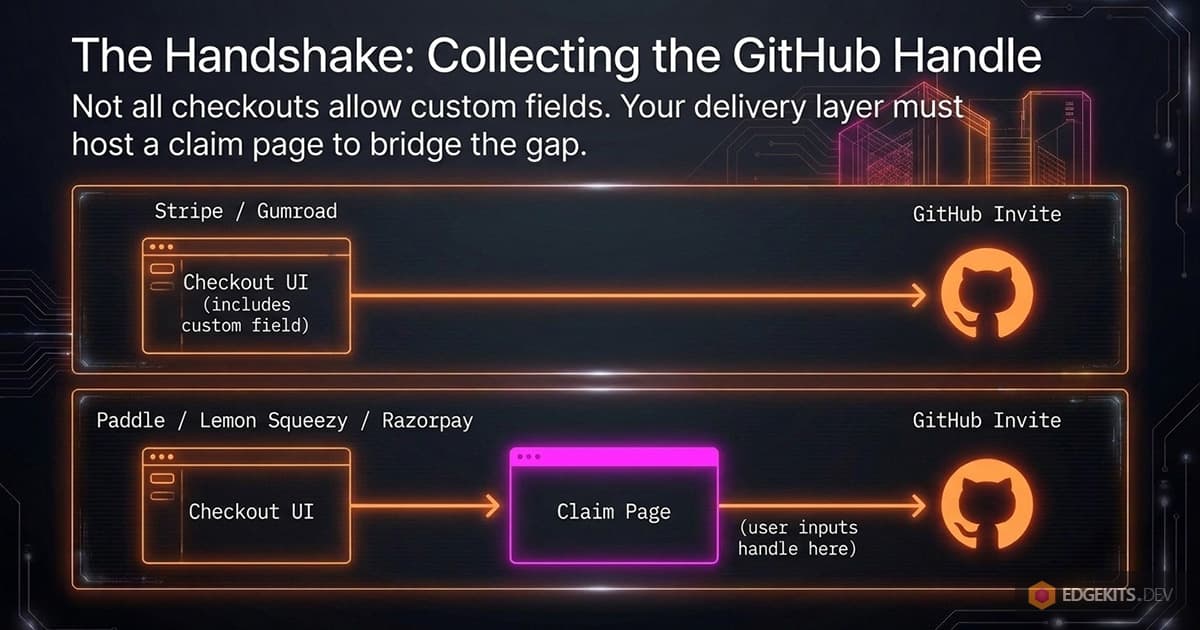
The rails differ in one practical detail: whether the buyer can type a GitHub username at checkout. Stripe’s Checkout and Gumroad’s product pages can carry a custom field, so the handle arrives with the payment. Paddle’s checkout has no buyer-facing field, so the handle is collected on a storefront you host before the checkout opens, or on a claim page after it.
Lemon Squeezy and Razorpay pass only seller-side custom data, so the claim page is the normal route: the buyer pays, lands on a page your delivery layer serves, types the handle once, and gets the invite by email. On Telegram Stars the bot asks, and checks that the account exists, before it takes the payment.
I built RepoAccess as that layer: one Cloudflare Worker on your own account, one adapter per rail, one internal event shape. The AGPL core on npm carries the Stripe adapter for free, and the paid tier adds Paddle, Lemon Squeezy, Gumroad, Razorpay and Telegram Stars. The provider guides go deeper on each: Paddle, Lemon Squeezy on its way to Stripe Managed Payments, and Telegram Stars.
The reason to keep this layer separate from the rail is the next section. The rails in the table are not equally stable, and the one most sellers outside Stripe’s list have converged on is the one in motion.
Merchant of record or payment gateway: who carries the tax when you sell code from abroad
A merchant of record is the legal seller on the invoice. Paddle, Lemon Squeezy, Gumroad, Polar and Dodo all take that role: they register for VAT, GST and US sales tax where it applies, collect it at checkout, remit it, and handle the disputes. You receive a payout, net of their fee, and your tax life at home is about that payout and nothing else.
A payment gateway leaves you as the seller. Stripe, in its standard form, and Razorpay are gateways, so registration and remittance abroad are yours. For a seller in the 44 countries that is a real choice. For a seller outside them, it is Razorpay in India or nothing, which is why the merchants of record dominate this market.
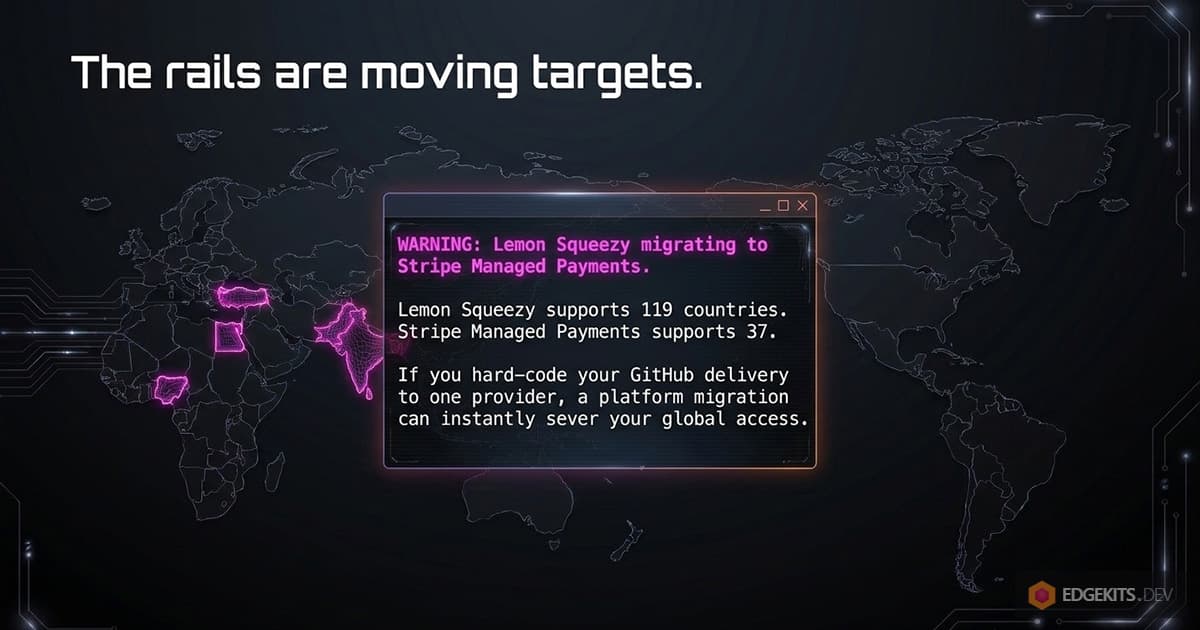
Stripe’s own merchant-of-record product, Managed Payments, has been generally available since April 2026 at 3.5% on top of its payment fees, but it takes sellers from 37 business locations: the United States, Canada, 31 European countries, Australia, Hong Kong, Japan and Singapore. None of the countries in the 70-country group above is on that list. Paddle’s own read of the product makes the same point from the competitor’s side, naming Turkey, India, Brazil and Mexico among the markets it does not serve.
That matters because Lemon Squeezy, which pays out to 119 countries, has said its direction is a migration to Managed Payments. All 37 supported locations are inside Lemon Squeezy’s 119; the other 82 are not, and nobody has said what happens to sellers there. If you are among them, plan for the rail under your checkout to change, and make sure the delivery does not change with it.
How you get paid: payout channels, minimums and the rules at home
Paddle pays monthly, by wire or Payoneer, once your balance passes $100, and warns that a $15 SWIFT fee may apply in some countries. Lemon Squeezy pays on the 1st and 15th to a bank account in USD or to PayPal, from $50, after a 13-day hold. Gumroad pays to a local bank account in the local currency only, from $100, or through PayPal in USD with a 2% fee where it has no bank route; sales sit for 7 days before a weekly, monthly or quarterly payout.
The channel matters as much as the schedule. Gumroad’s own page warns that PayPal cannot receive money for accounts registered in some countries even where Gumroad offers it there, so the bank list, not the PayPal fallback, is the one to check for your country. Read your provider’s payout page with your own country in mind before you read its fee page.
Then there are the rules at home, and they are about the currency of the payout, not the platform. Pakistan’s central bank lets IT exporters keep USD 5,000 a month or half of their export proceeds in a foreign-currency account, whichever is higher, under chapter 12 of the SBP foreign exchange manual. Bangladesh Bank’s FEPD Circular 22 of July 2026 lets an ICT exporter keep up to half of net earnings in foreign currency and says the rest “shall be mandatorily converted into Taka”. Turkey raised its income-tax deduction on services exported abroad from 80% to 100% for 2026 under Presidential Decree 11257, on condition that the whole of the earnings is brought into Turkey by the filing deadline.
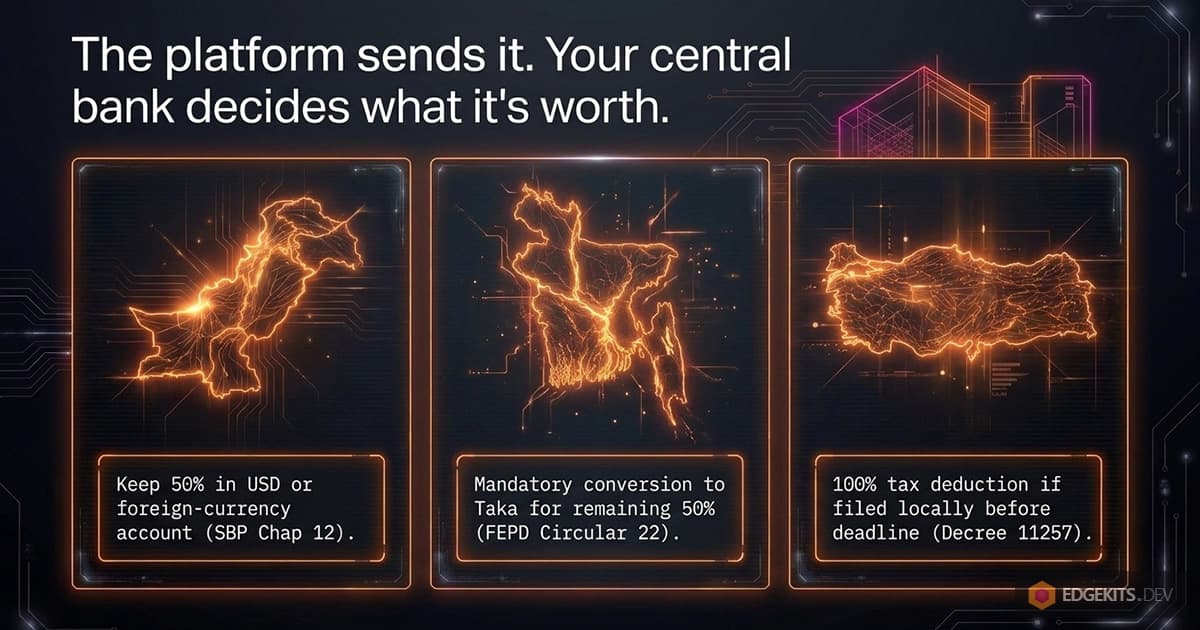
Three countries, three different answers, and none of them was about Paddle or Lemon Squeezy. That is the pattern: the provider decides whether you can sell, your central bank and tax office decide what a payout is worth once it lands. I am not going to summarise five tax codes in an article about payment rails; the point is that this is the research to do next, for your country, before you pick a payout currency.
Pick your rail in three questions
First, is your country on the provider’s list, on its bank list rather than its PayPal fallback. For most of the 70-country group the answer is yes for Paddle, Lemon Squeezy and Gumroad, and the choice moves to the next question. For India, Razorpay joins the list; for anyone who would rather have no bank at all, Telegram Stars is on it from the start.
Second, do you want a merchant of record. If you sell to buyers in the EU, the UK or the United States, a merchant of record spares you tax registrations you would otherwise have to make in places you have never been. That points at Paddle, Lemon Squeezy or Gumroad, and among them the fee difference is 5% + 50¢ for Lemon Squeezy against 10% + 50¢ for Gumroad, with Paddle at the same 5% + 50¢ as Lemon Squeezy.
Third, how do you get paid, and what happens to the money at home. A $100 monthly minimum by wire with a possible SWIFT fee is a different product from a twice-monthly PayPal payout from $50, and a mandatory conversion rule changes what either is worth. Answer that with your provider’s payout page and your own regulator’s circular open side by side.
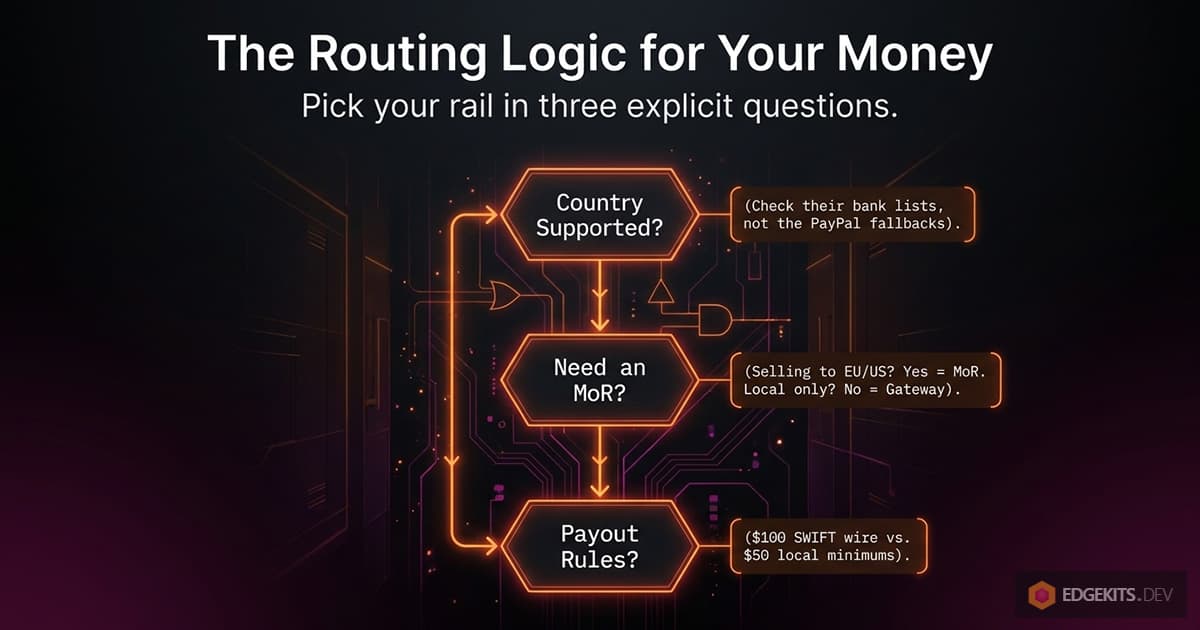
Whichever rail those three questions leave you with, the delivery step is the same shape: invite on payment, revoke on refund, a claim page for the handle. Build it once, keep it yours, and the rail becomes the part of your setup you are allowed to change your mind about.
What this approach gives up
Running your own delivery layer means running something. RepoAccess is a single Worker on a free Cloudflare account and the setup wizard takes about an hour, but the pager for that hour and after is yours, and a provider that changes its webhook shape is a change you or your tool’s maintainer has to track. Polar and Dodo take that away by owning the whole path, at the price of their fee on every sale and their list of what a GitHub delivery can do.
The country data in this article is also a snapshot. Paddle’s unsupported list grew by one country between my two readings this month, Stripe lists India and Indonesia only as previews, and Lemon Squeezy’s future is a migration whose terms for 82 countries have not been written. Read the linked pages, dated, before you build on any number here.
Frequently Asked Questions
Can I use Paddle to sell code if Stripe is not available in my country?
Almost certainly. Paddle's own supported-countries page says it works with software businesses anywhere in the world except an unsupported list of 23 countries and territories plus five regions of Ukraine, and the list is mostly sanctioned jurisdictions such as Russia, Iran, Syria and North Korea. Paddle is a Merchant of Record, so it becomes the seller on the invoice and handles sales tax, VAT and disputes. It pays out monthly by wire or Payoneer with a $100 minimum. Its checkout has no field for a GitHub username, so delivering a private repo needs either a storefront you host that collects the handle before the Paddle checkout opens, or a claim page the buyer visits after paying. RepoAccess Pro ships both, keyed to Paddle's transaction and adjustment webhooks.
Which merchant of record works for sellers based in India?
For a seller registered in India the merchant-of-record options with bank payouts are Lemon Squeezy, Gumroad, Polar and Dodo Payments, and Paddle accepts Indian sellers as well. Stripe itself lists India only as a preview, and Stripe Managed Payments does not list India among its 37 supported business locations at all. Razorpay is the domestic route: it is a payment gateway, not a merchant of record, so tax stays with you, but it settles in INR to an Indian bank and takes UPI and local cards. RepoAccess Pro includes a Razorpay adapter that grants GitHub access on a captured payment and revokes it on a refund or dispute, with the buyer's username collected on a claim page.
What happens to my Lemon Squeezy store if my country is not on the Stripe Managed Payments list?
Nothing has been announced, and I will not guess. Lemon Squeezy pays out to bank accounts in 119 countries, Stripe Managed Payments accepts sellers from 37 business locations, and all 37 are inside the 119. That leaves 82 Lemon Squeezy countries, among them Turkey, Pakistan, Nigeria, Bangladesh, Egypt and India, with no documented seat in the product Lemon Squeezy says it is migrating toward. Today the store keeps working: there is no shutdown date, the sign-up form is live and webhooks fire. The practical protection is to keep delivery off the rail, so that if you have to move to Paddle or Gumroad later, the GitHub invites and revokes do not move with it.
Does Gumroad pay out to sellers in countries where Stripe does not work?
Gumroad pays to bank accounts in 119 listed countries, in the local currency only, with a standard $100 minimum and a 7-day hold on weekly, monthly and quarterly schedules. Where bank payouts are not offered it pays through PayPal in USD with a 2% fee, and it names Zambia, Syria, Russia and Iraq 'and a number of others' as places where neither works. Its 119 bank countries include Turkey, Pakistan, Nigeria, Bangladesh and Egypt. Gumroad is a merchant of record and its product pages can carry a custom field, so a buyer can type a GitHub username at checkout; the invite and the refund-driven revoke still need a separate delivery layer, which is what the RepoAccess Gumroad adapter does.
Do I need a SaaS to deliver GitHub repo access after a Paddle or Lemon Squeezy sale?
No. The delivery step is a webhook receiver that calls the GitHub API: on a completed payment it adds the buyer to the team that carries your repo, and on a refund or chargeback it removes them. That can be a script on a VPS, a Zapier automation, or a Cloudflare Worker on your own account. RepoAccess is the Worker version: the free AGPL core ships the Stripe adapter, and Pro adds Paddle, Lemon Squeezy, Gumroad, Razorpay and Telegram Stars as a one-time licence with no per-sale cut. Whichever you pick, the point is that the delivery is yours, so the payment provider becomes a setting you can change.
Is Razorpay a merchant of record?
No. Razorpay is a payment gateway: you remain the seller of record, and registration and remittance of GST or any foreign tax stay with you. It differs from Paddle, Lemon Squeezy and Gumroad exactly there, and it is the reason it belongs to Indian sellers rather than to the world. Its Import Flow lets a business registered outside India accept payments from Indian buyers, settled to an overseas SWIFT bank account, but that is a way to sell into India, not a way out of a country Stripe does not serve. For a seller in India it is the one rail that settles in INR with UPI at checkout.
Can I sell GitHub repo access without any bank account at all?
Yes, through Telegram Stars. A Telegram bot is the storefront, the buyer pays in Stars, and there is no merchant onboarding and no country list, because there is no bank in the loop. Accumulated Stars convert at an equivalent of 0.013 USD per Star, become available up to 21 days after receipt, and are withdrawn through Fragment as Toncoin into a TON wallet you control, 1,000 Stars at a time. Refunds are seller-initiated through the bot, so nothing is reversed behind your back. RepoAccess Pro includes a Stars adapter in which the bot asks for the GitHub username, validates that the account exists, and revokes access in the same action that returns the Stars.
Resources & Further Reading
- Stripe - Global availability
- Stripe - Managed Payments eligibility
- Paddle - Which countries are supported by Paddle?
- Lemon Squeezy - Supported countries
- Gumroad - Getting paid
- Polar - Supported countries
- Razorpay - International payments
- Telegram - Bot Developer Terms
- RepoAccess Core - GitHub repository
- RepoAccess Pro - product page